研究问题与动机
- 研究问题:很多 GraphRAG 默认 KG 是可靠的,但实际 LLM 构图会产生错关系、错实体绑定、关系方向翻转、缺桥接边和缺限定信息。这些问题进入多跳检索后,会把检索轨迹带偏,或让系统在结构证据不足时继续传播伪 binding。
- 为什么重要:GraphRAG 的错误不只来自最终 LLM 幻觉,也可能来自检索阶段对错误 KG 结构的过度信任。若不区分“图里有噪声”和“图里缺证据”,系统会把局部看起来相关的 triple 当作可继续推理的证据。
- 现有路线:
- LogicPoison - Logical Attacks on GraphRAG 关注恶意拓扑污染,说明 GraphRAG 对路径和桥接边很敏感。
- GraphSteal - Structural Knowledge Stealing from GraphRAG 关注结构隐私泄露,说明图接口暴露的局部结构本身有风险。
- A2RAG - Adaptive Agentic Graph Retrieval、TechGraphRAG - Agentic Graph-Augmented RAG Framework 和 NaviRAG - Active Knowledge Navigation for RAG 都在讨论 evidence sufficiency / stop / fallback,但 CS-RAG 把 sufficiency 明确绑定到 KG 候选分布和变量传播。
- 对本知识库的意义:CS-RAG 把 GraphRAG中的知识图谱噪声传播 从攻击/构图质量扩展到 retrieval-time mitigation:不一定先修 KG,而是在每一跳判断“这个结构 binding 是否足够可靠,可以继续传播”。
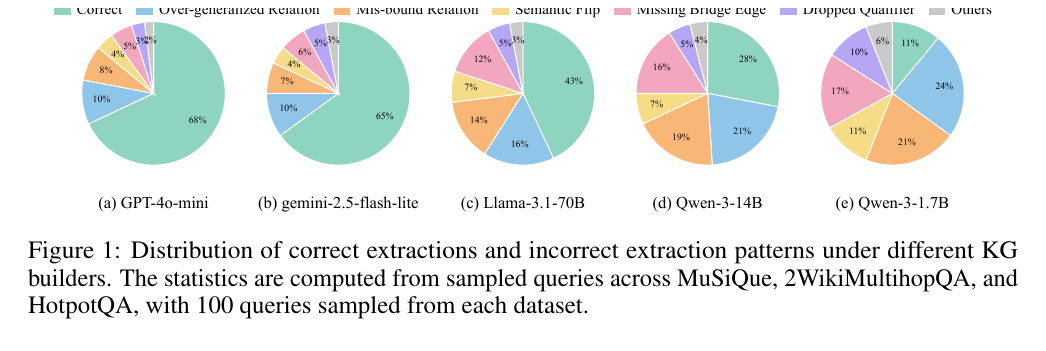
Figure 1 的关键信号是:不同 LLM builder 都会产生不同比例的错误 tuple;即使强 builder,也不是所有 query-relevant 支持句都能被正确抽取。论文把错误聚合成两类:spurious noise 触发 retrieval drift,incomplete information 触发 retrieval hallucination。
- Reliable-KG assumption:多数 GraphRAG 方法默认 KG 足够可靠,只在图上做 PPR、beam search、path reranking 或社区摘要。
- Coarse semantic matching:如果只看 query-triple 语义相似度,mis-bound relation、over-generalized relation 和 semantic flip 仍可能进入候选池。
- Forced structural continuation:当 bridge edge 或 qualifier 缺失时,系统仍可能沿弱连接继续传播变量,产生 unsupported binding。
- KG repair cost high:直接重抽、验证或人工修 KG 成本高,尤其在多 builder、多数据集或本地部署场景中不可持续。
- Sufficiency not explicit:已有方法常有 stop / fallback 概念,但缺少一个能解释“为什么当前 hop 可以或不可以传播”的候选分布级判据。
方法与机制
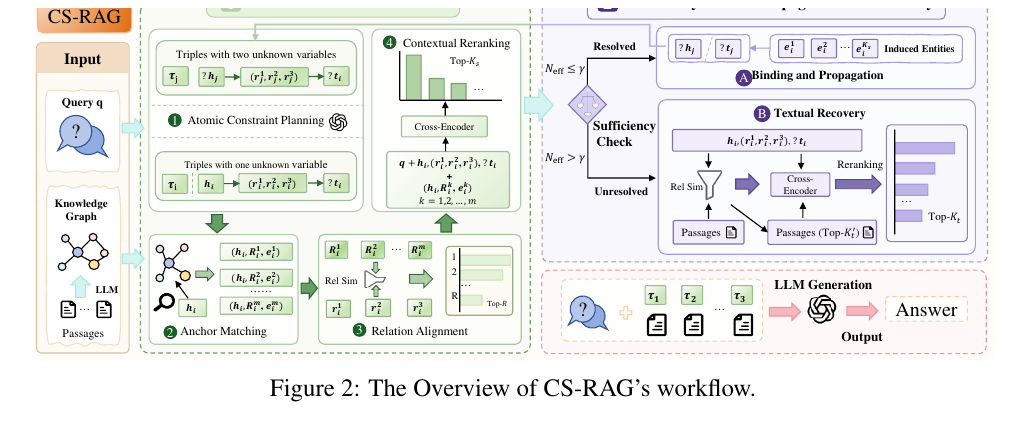
1. 总体框架:Query -> Constraint Plan -> Structured Retrieval -> Sufficiency Decision -> Text Recovery / Binding Propagation
输入:问题 $q$、LLM 构建的知识图谱 $G=(E,R,T)$、query-specific passages $U(q)$、结构候选预算 $K_s$、文本恢复预算 $K_t$、sufficiency threshold $\gamma$。
计算链路:
- Atomic Constraint Planning:LLM 把多跳问题规划成有序原子约束:
其中 $h_i,t_i$ 可以是问题中的常量实体,也可以是中间变量 $V={?v_1,?v_2,\ldots}$。每个约束还生成 relation variants:
- Constraint-based Retrieval:先执行只有一个未知变量的约束:
- Sufficiency-Guided Propagation and Recovery:对每个约束的 refined candidate pool 判断是否足够支持变量 binding。
- LLM Generation:把 resolved structural evidence 和 unresolved textual evidence 组织成 constraint-aligned context,生成答案。
输出:最终答案、每个原子约束的 resolved / unresolved 状态、变量 binding、结构证据、文本恢复证据。
直观解释:CS-RAG 把 GraphRAG 的多跳检索从“沿图走”改成“逐条执行约束”。每一跳必须先证明结构候选足够集中,才允许把变量带到下一跳。
2. Atomic Constraint Planning:把问题转成带变量的可执行约束
输入:自然语言问题 $q$。
计算链路:
- 抽出 query entities $E_q$ 和中间变量 $V$。
- 生成 ordered constraints $P$,每个 constraint 是一个 triple pattern。
- 为每个 relation 生成多个语义变体 $R_i$,作为后续 relation alignment 的目标。
输出:原子约束序列 $P$ 和 relation variants ${R_i}$。
直观解释:planner 的作用不是直接回答,也不是直接检索文本,而是把多跳问题变成一组可以在 KG 中逐步执行的结构约束。
3. Anchor Matching + Relation Alignment + Contextual Reranking
输入:单变量约束 $\tau_i\in P_1$、anchor surface $e_i^{surf}$、KG triple set $T$、relation variants $R_i$。
计算链路:
- Anchor Matching:用 top-3 token-coverage matching 把 $e_i^{surf}$ 映射到 KG anchor nodes $E_i^{anchor}$。
- One-hop Enumeration:从 anchor nodes 枚举一跳邻域,形成候选池 $C_i$。
- Relation Alignment:比较候选 triple 的 KG relation 和 $R_i$,保留 top-$R$ relation-aligned candidates,得到 $C_i^{init}$。
- Contextual Reranking:cross-encoder 输入 query、linearized constraint 和 candidate triple,得到分数 $z_{i,c}$,保留 top-$K_s$:
输出:当前约束的 refined structural candidate pool $C_i^{top}$。
直观解释:这一步防 retrieval drift。候选不仅要连到 anchor,还要满足当前 hop 的 relation semantics;否则只是实体相关,不能算 constraint-compatible evidence。
4. Neff Sufficiency Check:只传播足够集中的结构 binding
输入:候选池 $C_i^{top}$ 和 cross-encoder 分数 ${z_{i,c}}$。
计算链路:
- 对候选分数做 softmax:
- 计算 effective number of candidates:
- 用阈值 $\gamma$ 判断状态:
$$ \operatorname{State}(\tau_i)= \begin{cases} \text{Resolved}, & N_{\mathrm{eff}}(\tau_i)\le \gamma\
原始笔记摘录已截断;请打开来源笔记阅读完整内容。
证据与结果
1. 跨 KG builder 鲁棒性
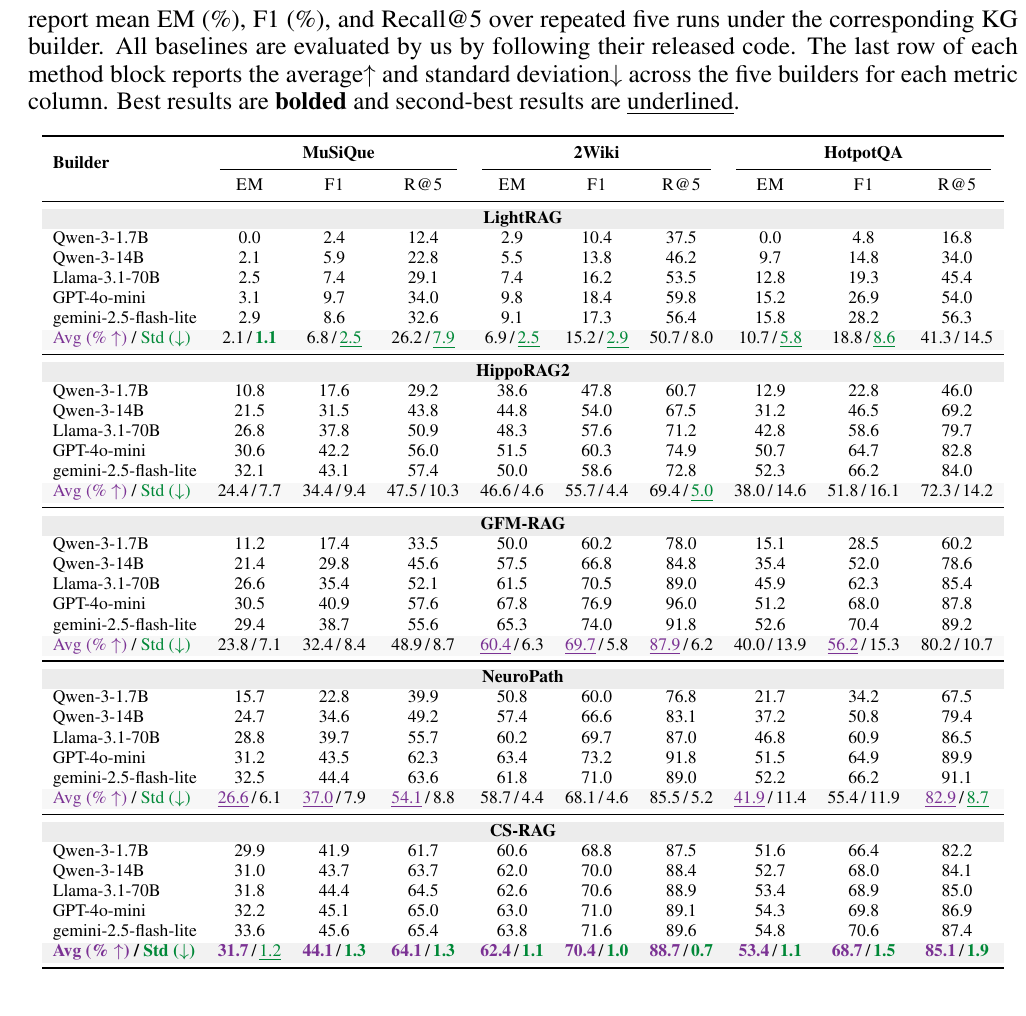
Table 1 的核心结论是:CS-RAG 在 MuSiQue、2Wiki 和 HotpotQA 上都取得最高 cross-builder average,并且标准差很低。例如平均 F1 分别为 MuSiQue 44.1、2Wiki 70.4、HotpotQA 68.7;对应 std 为 1.3、1.0、1.5。这说明 CS-RAG 对 KG builder 质量差异不那么敏感。
2. 受控 KG issue injection
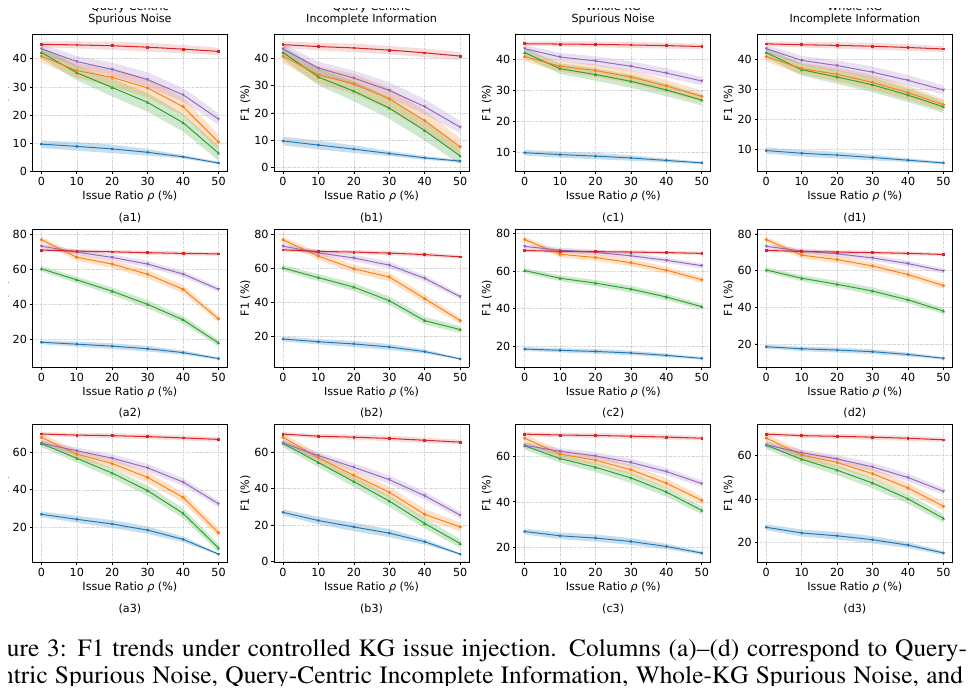
Figure 3 把问题注入分成 query-centric / whole-KG 两种范围,以及 spurious noise / incomplete information 两种类型。随着 issue ratio $\rho$ 从 0.1 到 0.5 增加,基线 F1 明显下降,而 CS-RAG 曲线基本稳定。这个实验直接支持“constraint retrieval 防 drift,sufficiency + textual recovery 防 hallucinated continuation”。
3. 消融:planner、relation alignment、sufficiency check 都不可替代
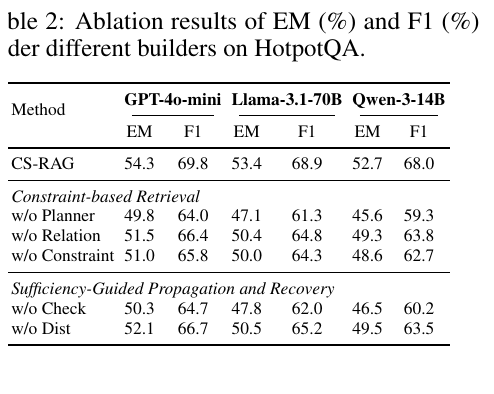
Table 2 显示在 HotpotQA 上,去掉 Planner、Relation、Constraint、Check、Dist 都会下降。w/o Planner 下降最大,说明原始 query 不能替代 hop-wise constraints;w/o Check 会强制传播不可靠结构候选,说明 sufficiency check 是防 retrieval hallucination 的关键。
4. $\gamma$ 是结构传播与文本恢复的成本-质量旋钮
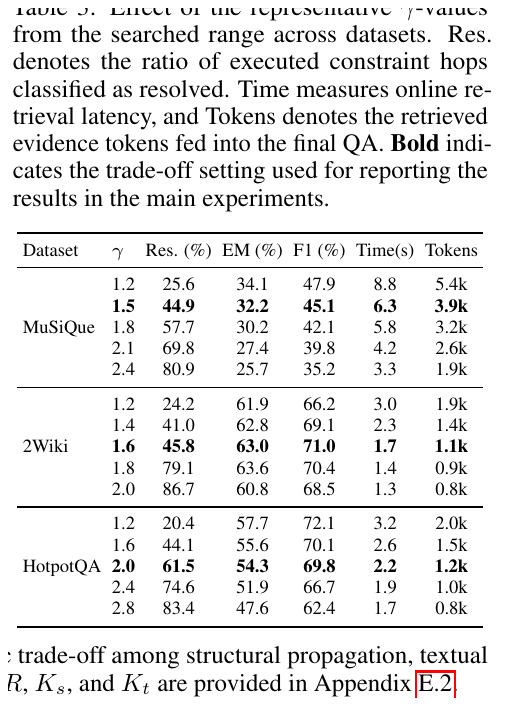
Table 3 显示 $\gamma$ 越大,resolved-hop rate 越高,latency 和最终上下文 tokens 越低;但过大的 $\gamma$ 会让弱 binding 更容易被接受。MuSiQue 更偏向小 $\gamma$ 和更多 textual recovery;2Wiki 在中等 $\gamma$ 处达到更好 trade-off;HotpotQA 也体现准确率-成本折中。
5. Sufficiency check 的正确性与效率边界
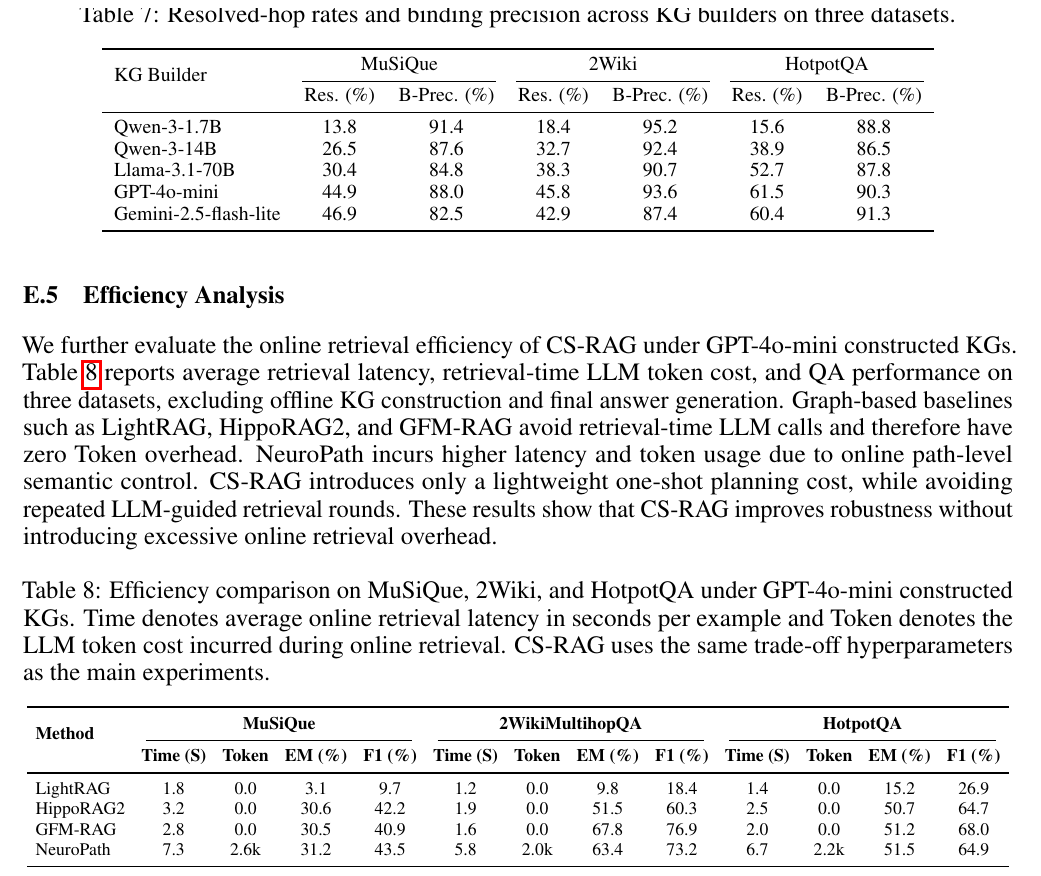
Table 7 显示 weaker builders 的 resolved-hop rate 更低,但 resolved 后的 binding precision 仍较高,说明 Neff 能过滤不确定结构候选。Table 8 显示 CS-RAG 引入 one-shot planning token cost,但没有像多轮 LLM-guided traversal 那样反复调用;在 GPT-4o-mini KG 上,MuSiQue / 2Wiki / HotpotQA 的 retrieval-time tokens 约为 0.86k / 0.72k / 0.76k。
6. Case trace:resolved 传播,unresolved 转文本
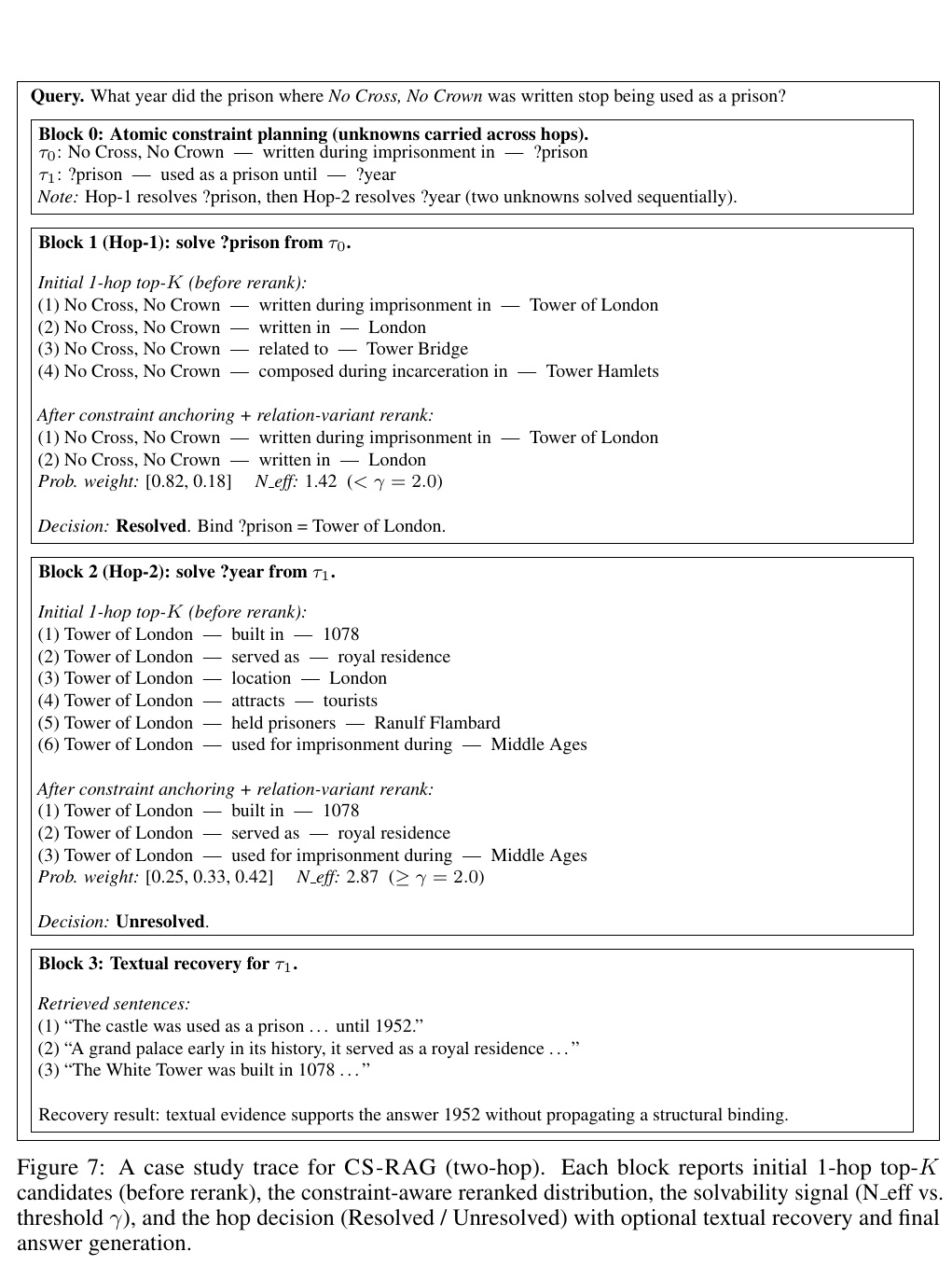
Figure 7 的两跳例子说明执行逻辑:第一跳候选集中,$N_{\mathrm{eff}}=1.42<\gamma=2.0$,系统绑定 ?prison = Tower of London;第二跳候选分布不集中,$N_{\mathrm{eff}}=2.87\ge\gamma$,系统不传播结构 binding,而是启动 textual recovery,最终从文本中恢复 1952。
局限与开放问题
-
Planner 仍是前置风险:如果 atomic constraint planning 漏掉 bridge variable 或把 relation 规划错,后续检索会围绕错误目标执行。
-
Textual recovery 依赖 passage pool:如果 KG 缺桥接证据,文本池也没有明确 bridge evidence,CS-RAG 只能阻止错误传播,不能凭空恢复答案。
-
$\gamma$ 需要按数据集/任务调节:MuSiQue、2Wiki、HotpotQA 的最佳 resolved-hop / latency / tokens trade-off 不同。
-
评测仍集中在 Wikipedia multi-hop QA:对于代码库、表格/公式、医疗、法律或企业 schema 图,需要重新验证 atomic constraint 和 Neff 的适配性。
-
KG repair 没有解决:CS-RAG 是 retrieval-time mitigation,不会从根本上修复抽取器、构图器或长期 graph memory 的错误积累。
-
代码仓库未声明 license,README 有桌面系统和本地部署说明,但正式复现完整结果仍需进一步跑通。
-
把 Neff sufficiency 接入 GraphRAG中的停止准则与预算分配形式化:记录每一跳的 $N_{\mathrm{eff}}$、resolved/unresolved、binding precision、text fallback trigger 和最终 answer-used evidence。
-
和 LogicPoison - Logical Attacks on GraphRAG 对照:测试 CS-RAG 对恶意 entity swapping / path poisoning 是否同样有效,区分自然 imperfect KG 与 adversarial topology attack。
-
和 DOTRAG - Retrieval-Time Reasoning Along Paths、PRoH - Dynamic Planning over Knowledge Hypergraphs 对照:把 path-level / hyperedge-level sufficiency 变成可学习或可校准的 acceptance criterion。
-
扩展到 CacheRAG - Semantic Caching for KGQA:缓存的不只是 query plan,还可以缓存 constraint plan、resolved-hop statistics、fallback decision 和 stale-plan failure。
-
做 sample-level 诊断:把错误拆成 planner error、anchor miss、relation alignment miss、Neff false accept、Neff false reject、text recovery miss、generation error。
-
用于训练信号:把 support gain、binding precision、unresolved fallback success、retrieval-turn utility 纳入 GraphRAG RL 或 reranker training。
关联与拓展
- GraphRAG的鲁棒性框架:CS-RAG 补充自然 imperfect KG 的鲁棒检索,而不只是恶意攻击或结构隐私。
- GraphRAG中的知识图谱噪声传播:spurious noise 对应错边传播,incomplete information 对应缺桥接边/缺 qualifier 导致的 unsupported continuation。
- GraphRAG中的Bridge Evidence 为什么关键:missing bridge edge 是 retrieval hallucination 的核心触发因素。
- GraphRAG中的Evidence Utility 而非 Evidence Quantity:CS-RAG 的 Neff 强调候选分布质量,不是简单增加 top-k。
- GraphRAG中的接口-代理-停止决策闭环:resolved 走 structural propagation,unresolved 走 textual recovery,是一个具体的 graph/text routing policy。
- 2026-06-09-Open-Problems:直接连接 OP-5、OP-9、OP-10、OP-11、OP-12、OP-17。
研究问题入口
Q2 图构建与表示, Q3 证据检索与集合形成, Q4 查询规划与执行, Q5 动态状态与学习策略, Q6 证据来源与可解释性, Q7 鲁棒性与安全, Q8 效率与部署, Q9 评测与理论