GGraphRAG 文献图谱自动同步
LIT-7B4F4239 · 2026

DOTRAG - Retrieval-Time Reasoning Along Paths

DOTRAG 把 GraphRAG 检索改写为 goal-constrained path-finding,在每个 query-specific DOT 工作区内用 LLM 生成路径约束、局部向量检索候选节点、Yen shortest paths 构造候选路径,再用 LLM 判断路径是否 partial / complete。

PDF 级阅读卡优先级 P0Larnell Moore, Naihao Deng, Rada Mihalcea, Farnaz Jahanbakhsh发表信息待核验
内容状态:PDF 级阅读卡。结构化摘录继承当前知识库的来源等级;具体 claim 应回到一手论文核验。

研究问题与动机

  • 研究问题:现有 GraphRAG 多数仍是 retrieve-then-reason:先用固定启发式、PPR、flow pruning 或 top-k graph expansion 取上下文,再让 LLM 在 retrieved context 上推理。这种模式在多跳问题上容易取到语义相关但路径错误的噪声,或者漏掉真正需要的 relational path。

  • 为什么重要:多跳 QA 的关键证据通常不是孤立节点,而是从 anchor entity 出发、满足 query-specific constraint 的路径。固定 traversal 不能根据问题动态改变“哪些中间节点有意义、哪些终点满足问题”。

  • 对本知识库的意义:DOTRAG 是 BubbleRAG - Evidence-Driven RAG for Black-Box KGs、STAR - Semantic-Tuned and Tail-Adaptive Retriever for GraphRAG、FastInsight - Fast and Insightful Retrieval via Fusion Operators for Graph RAG 之后,进一步把 GraphRAG 检索从 evidence subgraph / path scorer 推到 retrieval-time reasoning 的代表工作。

  • Heuristic traversal mismatch:固定 hop、固定 PPR 或 flow-based pruning 难以适配不同 query 的目标路径。

  • Noise accumulation:扩图越大,越容易把无关节点和边放进 context,降低生成质量。

  • Path as byproduct:HopRAG / RoE 这类方法会在遍历过程中形成路径,但路径通常是逐步决策的副产物;DOTRAG 明确把完整 relational path 当作检索对象。

  • Global embedding interference:全局向量检索容易被高频、语义泛化的节点干扰,局部 query 需要局部化语义搜索空间。

  • Evaluation gap:很多 GraphRAG 论文只报告答案质量,缺少 node-level retrieval precision / recall / F1,无法解释错误来自检索还是生成。

方法与机制

1. Graph-Structured Indexing:先构建实体-关系图

输入是语料 $D_c$。DOTRAG 使用 LightRAG / PathRAG 一类 graph construction pipeline 构建:

G=(E,R)

其中 $E$ 是实体节点,$R$ 是关系边。每个 entity 有 type、textual description 和 linked source chunks;每条 relation 有 textual description 和 keywords,并被 embedding 后写入 vector store。

额外输入是 schema metadata:

O=\{(t_i,def_i)\}, \quad \delta

其中 $O$ 是实体类型及其定义,$\delta$ 是自然语言 graph description。这个设计说明 DOTRAG 不是完全 schema-free,它需要用户或系统提供图的类型解释和全局用途说明。

2. Neighborhood Selection:从 query 找 anchor concepts

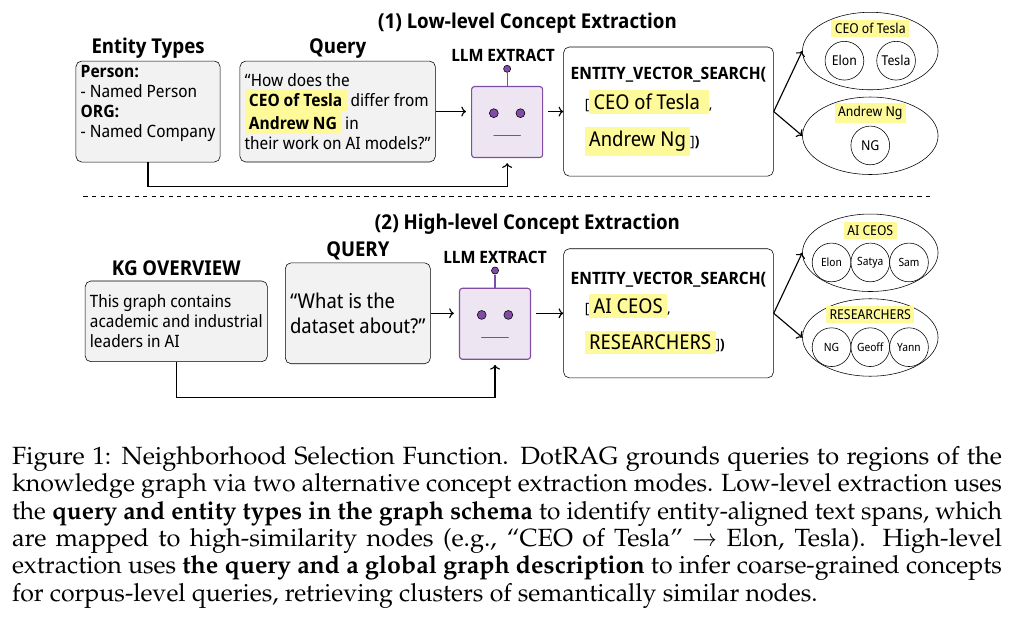
Figure 1 展示两种 anchor extraction:

  • Low-level concept extraction:用 query 和 entity type definition 找具体实体跨度,例如 “CEO of Tesla” 和 “Andrew Ng”。
  • High-level concept extraction:当 query 更抽象时,用 graph description $\delta$ 推断 coarse concept,例如 “AI CEOs” 和 “Researchers”。

LLM 先生成 low-level concepts $L={l_i}$ 和 high-level concepts $H={h_j}$,再选择:

C= \begin{cases} L, & \text{query has precise entity anchors}\\ L\cup H, & \text{query needs abstract or corpus-level grounding} \end{cases}

对每个 concept $c_i\in C$,在 entity embedding 上做相似检索:

S_i=\{e\in E\mid sim(c_i,e)\ge \tau\}

或在 high-level concept 下取 top-$k$ nodes。输出是 concept-to-anchor mapping:

c_i \mapsto S_i

3. Neighborhood Construction:为每个 concept 建 DOT 工作区

DOT 是 Division of Thought,表示一个独立的局部检索工作区:

D_i=\langle S_i,G_{D_i},r_{int}^{(i)},r_{term}^{(i)},O_q^{(i)}\rangle

其中:

  • $S_i$:anchor source nodes。
  • $G_{D_i}$:围绕 anchor nodes 展开的受限子图。
  • $r_{int}^{(i)}$:中间证据规则,判断哪些路径片段有意义。
  • $r_{term}^{(i)}$:终止规则,判断什么路径满足 query。
  • $O_q^{(i)}$:query-specific entity type filters。

LLM 根据 query、schema 和 DOT concept 生成规则:

(r_{int}^{(i)},r_{term}^{(i)},O_q^{(i)})=H(D_i,L,q,O,\delta)

随后在图上做受限扩展:

G_{D_i}=Sub(D_i,G,O_q^{(i)},h_{max})

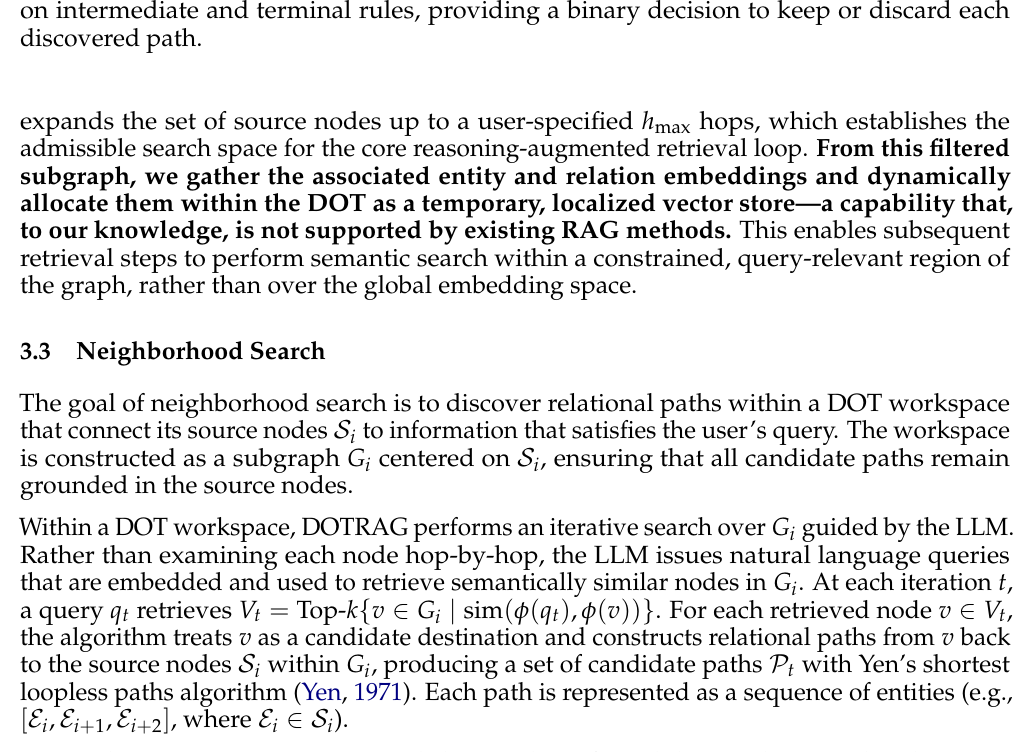
输出是多个局部 DOT subgraphs。每个 DOT 内部会动态建立临时 vector store,只在局部实体和关系 embedding 上检索。

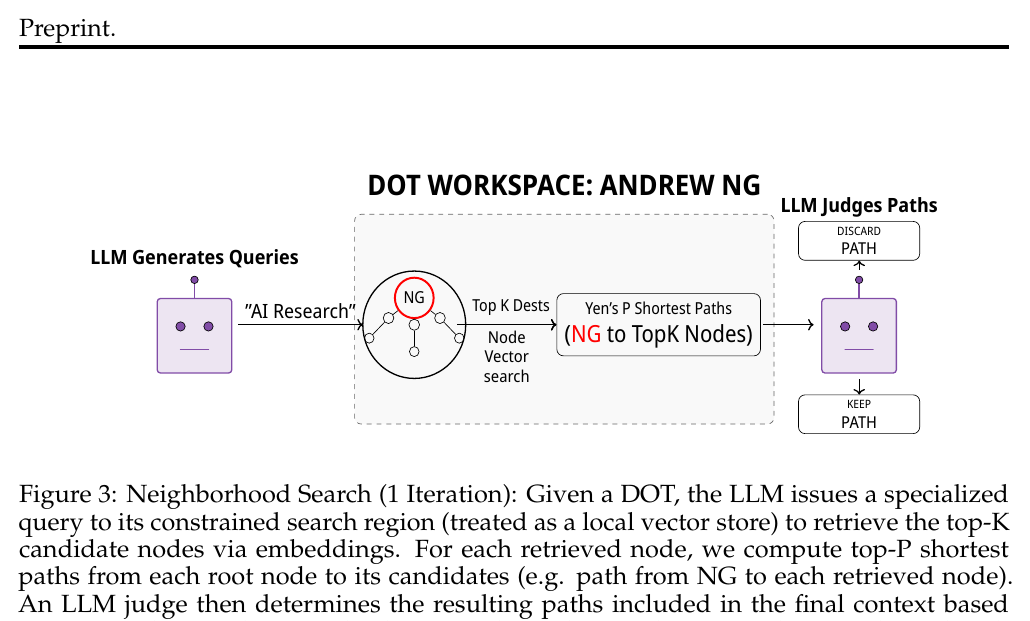
4. Neighborhood Search:检索时发现并判断路径

在第 $t$ 轮搜索中,LLM 生成局部查询 $q_t$,只在当前 DOT 的局部图 $G_{D_i}$ 上检索候选终点:

V_t=TopK\{v\in G_{D_i}\mid sim(\phi(q_t),\phi(v))\}

对每个候选终点 $v$,用 Yen shortest loopless paths 从 anchor nodes $S_i$ 到 $v$ 构造候选路径:

P_t=YenPaths(S_i,V_t;G_{D_i})

如果候选路径过多,按目标节点与 $q_t$ 的相似度保留 top-$C$:

P_t^{keep}=TopC(P_t,sim(\phi(q_t),\phi(v)))

然后把路径转成自然语言 relation sequence,交给 LLM 按 DOT-specific rules 判断:

y(p)=Judge_L(p,r_{int}^{(i)},r_{term}^{(i)})\in\{\text{irrelevant},\text{partial},\text{complete}\}

irrelevant path 被丢弃;partial / complete path 被保留。若已有更长路径覆盖某个 prefix,则去掉短 prefix,避免重复证据。

5. Iterative Follow-up Query:用 partial path 引导下一轮搜索

原始笔记摘录已截断;请打开来源笔记阅读完整内容。

证据与结果

1. 实验设置

  • 数据集:MetaQA 1-hop / 2-hop / 3-hop;UltraDomain-CS;UltraDomain-Mixed。
  • 规模:MetaQA 每个 hop 300 问,共 900;UltraDomain 两个子集共 200;总计 1,100 questions。
  • Baselines:TradRAG、LightRAG、PathRAG。
  • Backbone:GPT-4o-mini 用于各方法;GPT-4.1 用作 LLM-as-a-judge。
  • 默认 DOTRAG 设置:$h_{max}=3$,$T_{max}=3$。
  • 检索指标:node-level Recall、Precision、F1。
  • 生成指标:pairwise LLM judge win rate,维度包括 Comprehensiveness、Logicality、Relevance、Coherence、Overall。

2. 生成质量:多跳和跨域总体胜率高,但 CS 对 PathRAG 不占优

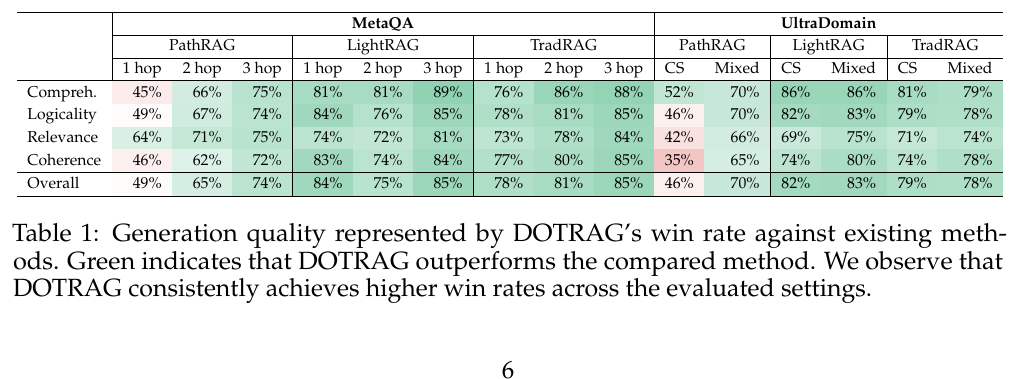
Table 1 报告 DOTRAG 相对 baselines 的 win rate:

  • MetaQA 上,DOTRAG 对 PathRAG / LightRAG / TradRAG 的 Overall win rate 在 2-hop / 3-hop 上通常更高,例如对 PathRAG 为 65% / 74%,对 LightRAG 为 75% / 85%。
  • UltraDomain-Mixed 上,DOTRAG 相对 PathRAG / LightRAG / TradRAG 的 Overall win rate 分别为 70% / 83% / 78%。
  • UltraDomain-CS 上,DOTRAG 对 PathRAG 的 Overall 只有 46%,说明并非所有构造出来的 CS query 都需要显式多跳路径推理;一些问题可能被更简单路径或更少上下文回答。

解读:DOTRAG 的收益主要来自 query 本身确实需要 multi-hop path dependency 的场景;如果问题实际偏单跳或中间节点冗余,完整路径证据可能反而降低 coherence。

3. 检索质量:MetaQA 2-hop / 3-hop F1 最强

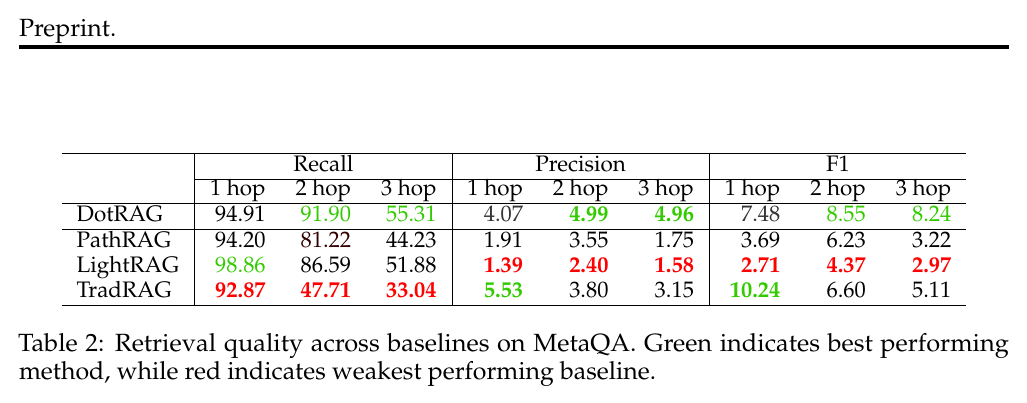
Table 2 显示:

  • 2-hop:DOTRAG Recall 91.90,F1 8.55,均高于 PathRAG / LightRAG / TradRAG。
  • 3-hop:DOTRAG Recall 55.31,F1 8.24,均为最佳。
  • 1-hop:TradRAG F1 10.24 最高,LightRAG Recall 98.86 最高;DOTRAG 保持竞争力但不是最佳。

解读:DOTRAG 对长路径更有价值。1-hop 任务不需要复杂路径约束,传统 chunk retrieval 可能用更少噪声命中答案。

4. 消融:3 iterations / 3 hops 是生成质量与检索覆盖的折中点

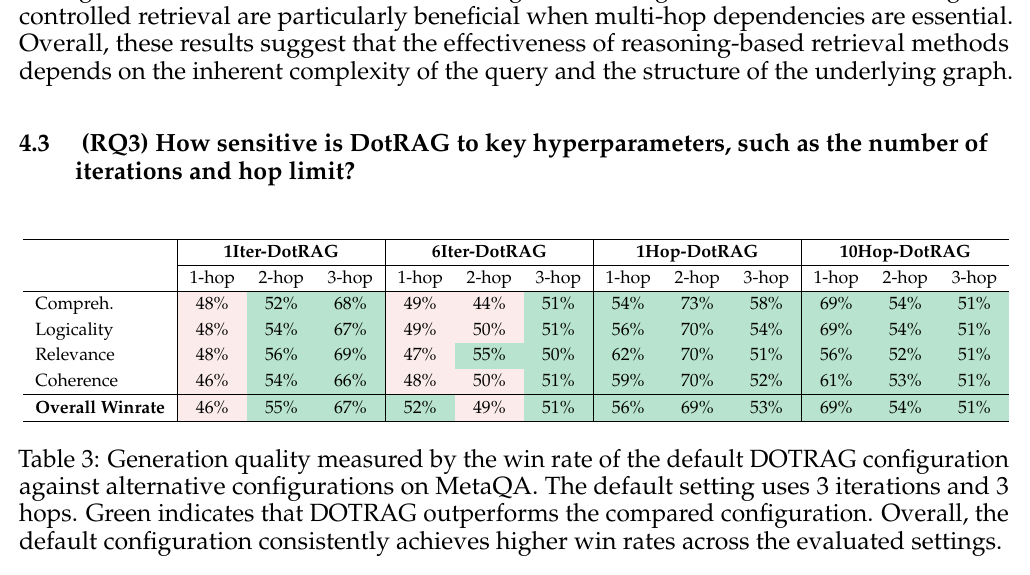
Table 3 比较默认 DOTRAG 与 1Iter、6Iter、1Hop、10Hop 配置的生成 win rate:

  • 1Iter 在 3-hop 上明显弱于默认设置,说明单轮搜索不足以逐步发现多跳路径。
  • 6Iter 在检索上可能提高 recall,但生成质量不稳定,说明更多路径不一定带来更好答案。
  • 1Hop 和 10Hop 都不是稳健选择:前者欠扩展,后者容易带入噪声。

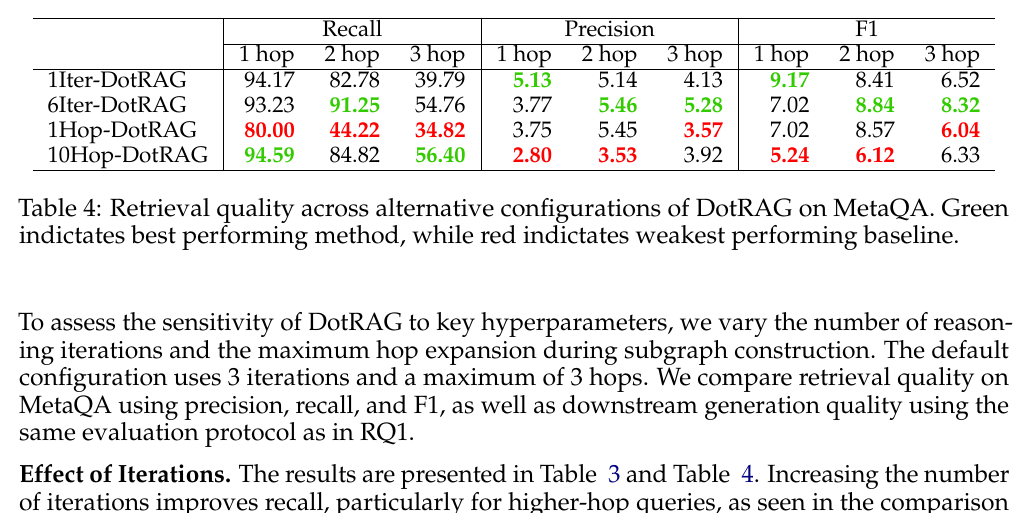
Table 4 显示:

  • 6Iter-DOTRAG 在 2-hop / 3-hop F1 上较强,但不对应稳定生成收益。
  • 10Hop-DOTRAG 提高部分 recall,例如 3-hop Recall 56.40,但 precision 下降明显。
  • 1Hop-DOTRAG recall 大幅下降,尤其 2-hop / 3-hop。

解读:GraphRAG 的核心不是盲目提高 coverage,而是控制 search budget 和 path acceptance,使 retrieved path 同时满足覆盖和低噪声。

局限与开放问题

  • 依赖 graph schema metadata:需要实体类型定义 $O$ 和全局 graph description $\delta$;论文实验中这些描述由用户检查后手动提供。

  • LLM prompt 依赖明显:concept extraction、DOT rule generation、path judgment、follow-up query 都依赖 LLM 稳定性。

  • 不是完全低成本:默认使用 GPT-4o-mini,评估使用 GPT-4.1 judge;每个 DOT 多轮搜索还要多次 LLM 判断路径。

  • MetaQA 评测没有 intermediate relation supervision:论文也指出原始 ground truth 只包含 starting node 和 endpoint,不能验证具体中间路径是否完全正确。

  • UltraDomain multi-hop questions 来自 sampled graph paths + LLM generation,可能包含不需要真实多跳推理的问题;CS 子集对 PathRAG 不占优就是信号。

  • Precision 绝对值仍低:Table 2 中 DOTRAG precision 约 4-5,说明即使有 DOT 约束,retrieved node set 仍比较宽。

  • 当前未提供官方代码链接,复现实验需要自己重建 graph construction、DOT prompts、YenPaths 和评估脚本。

  • 作者 Future Work:增强 MetaQA 的 intermediate hop supervision,以更细粒度评估多跳路径 traversal。

  • Agent 推断的 Research Opportunities:

    • 把 DOT rule generation 从 prompt-only 改成可记录的 structured path contract,显式保存 allowed entity types、intermediate predicates、terminal conditions。
    • 将 DOTRAG 与 STAR - Semantic-Tuned and Tail-Adaptive Retriever for GraphRAG 结合:STAR 训练 path scorer,DOTRAG 提供 query-specific local search space 和 path acceptance。
    • 将 DOTRAG 与 BubbleRAG - Evidence-Driven RAG for Black-Box KGs 对照:BubbleRAG 优化 evidence subgraph,DOTRAG 优化 query-conditioned accepted paths。
    • 扩展 OP-9:新增 path acceptance precision、partial-to-complete conversion rate、DOT-local retrieval recall、path-prefix redundancy rate。
    • 扩展 OP-10:把 DOT 作为 agentic traversal 的并行 workspace,记录每个 DOT 的 cost、accepted paths、follow-up queries 和 final-used paths。
    • 做 query router:1-hop / low-complexity query 走轻量 RAG 或 PathRAG,multi-hop dependency query 再启用 DOTRAG。

关联与拓展

研究问题入口

Q2 图构建与表示, Q3 证据检索与集合形成, Q4 查询规划与执行, Q5 动态状态与学习策略, Q6 证据来源与可解释性
展开原始论文笔记全文

基本信息

  • 英文标题:DOTRAG: Retrieval-Time Reasoning Along Paths
  • 中文标题:DOTRAG:沿路径进行检索时推理
  • 作者:Larnell Moore, Naihao Deng, Rada Mihalcea, Farnaz Jahanbakhsh
  • 机构:University of Michigan
  • 年份:2026
  • 版本:arXiv v1,2026-04-06
  • 链接:arXiv
  • PDF:查看论文原文
  • 代码:论文正文和 arXiv 页面未给出官方代码链接;本轮未找到可信官方仓库。
  • 阅读状态:PDF级
  • 所属方向:GraphRAG、retrieval-time reasoning、path retrieval、multi-hop QA
  • 优先级:P0

Background

Gap

  • Heuristic traversal mismatch:固定 hop、固定 PPR 或 flow-based pruning 难以适配不同 query 的目标路径。
  • Noise accumulation:扩图越大,越容易把无关节点和边放进 context,降低生成质量。
  • Path as byproduct:HopRAG / RoE 这类方法会在遍历过程中形成路径,但路径通常是逐步决策的副产物;DOTRAG 明确把完整 relational path 当作检索对象。
  • Global embedding interference:全局向量检索容易被高频、语义泛化的节点干扰,局部 query 需要局部化语义搜索空间。
  • Evaluation gap:很多 GraphRAG 论文只报告答案质量,缺少 node-level retrieval precision / recall / F1,无法解释错误来自检索还是生成。

Insight

  • 一句话创新点:DOTRAG 把 GraphRAG 检索改写为 goal-constrained path-finding,在每个 query-specific DOT 工作区内用 LLM 生成路径约束、局部向量检索候选节点、Yen shortest paths 构造候选路径,再用 LLM 判断路径是否 partial / complete。
  • 核心洞察:
    • 多跳检索不是“先多拿上下文再推理”,而是在检索过程中持续判断路径是否满足问题。
    • 每个 anchor concept 应该有自己的局部搜索空间,避免被全局语义空间干扰。
    • 路径需要作为 first-class retrieved object,而不是 traversal trace 的副产品。
    • 检索扩展要有边界:太少 iterations / hops 会漏证据,太多又会降低 precision 和 generation coherence。

Method

1. Graph-Structured Indexing:先构建实体-关系图

输入是语料 $D_c$。DOTRAG 使用 LightRAG / PathRAG 一类 graph construction pipeline 构建:

G=(E,R)

其中 $E$ 是实体节点,$R$ 是关系边。每个 entity 有 type、textual description 和 linked source chunks;每条 relation 有 textual description 和 keywords,并被 embedding 后写入 vector store。

额外输入是 schema metadata:

O=\{(t_i,def_i)\}, \quad \delta

其中 $O$ 是实体类型及其定义,$\delta$ 是自然语言 graph description。这个设计说明 DOTRAG 不是完全 schema-free,它需要用户或系统提供图的类型解释和全局用途说明。

2. Neighborhood Selection:从 query 找 anchor concepts

DOTRAG-fig1-neighborhood-selection

Figure 1 展示两种 anchor extraction:

  • Low-level concept extraction:用 query 和 entity type definition 找具体实体跨度,例如 “CEO of Tesla” 和 “Andrew Ng”。
  • High-level concept extraction:当 query 更抽象时,用 graph description $\delta$ 推断 coarse concept,例如 “AI CEOs” 和 “Researchers”。

LLM 先生成 low-level concepts $L={l_i}$ 和 high-level concepts $H={h_j}$,再选择:

C= \begin{cases} L, & \text{query has precise entity anchors}\\ L\cup H, & \text{query needs abstract or corpus-level grounding} \end{cases}

对每个 concept $c_i\in C$,在 entity embedding 上做相似检索:

S_i=\{e\in E\mid sim(c_i,e)\ge \tau\}

或在 high-level concept 下取 top-$k$ nodes。输出是 concept-to-anchor mapping:

c_i \mapsto S_i

3. Neighborhood Construction:为每个 concept 建 DOT 工作区

DOTRAG-fig2-neighborhood-construction

DOT 是 Division of Thought,表示一个独立的局部检索工作区:

D_i=\langle S_i,G_{D_i},r_{int}^{(i)},r_{term}^{(i)},O_q^{(i)}\rangle

其中:

  • $S_i$:anchor source nodes。
  • $G_{D_i}$:围绕 anchor nodes 展开的受限子图。
  • $r_{int}^{(i)}$:中间证据规则,判断哪些路径片段有意义。
  • $r_{term}^{(i)}$:终止规则,判断什么路径满足 query。
  • $O_q^{(i)}$:query-specific entity type filters。

LLM 根据 query、schema 和 DOT concept 生成规则:

(r_{int}^{(i)},r_{term}^{(i)},O_q^{(i)})=H(D_i,L,q,O,\delta)

随后在图上做受限扩展:

G_{D_i}=Sub(D_i,G,O_q^{(i)},h_{max})

输出是多个局部 DOT subgraphs。每个 DOT 内部会动态建立临时 vector store,只在局部实体和关系 embedding 上检索。

4. Neighborhood Search:检索时发现并判断路径

DOTRAG-fig3-neighborhood-search

在第 $t$ 轮搜索中,LLM 生成局部查询 $q_t$,只在当前 DOT 的局部图 $G_{D_i}$ 上检索候选终点:

V_t=TopK\{v\in G_{D_i}\mid sim(\phi(q_t),\phi(v))\}

对每个候选终点 $v$,用 Yen shortest loopless paths 从 anchor nodes $S_i$ 到 $v$ 构造候选路径:

P_t=YenPaths(S_i,V_t;G_{D_i})

如果候选路径过多,按目标节点与 $q_t$ 的相似度保留 top-$C$:

P_t^{keep}=TopC(P_t,sim(\phi(q_t),\phi(v)))

然后把路径转成自然语言 relation sequence,交给 LLM 按 DOT-specific rules 判断:

y(p)=Judge_L(p,r_{int}^{(i)},r_{term}^{(i)})\in\{\text{irrelevant},\text{partial},\text{complete}\}

irrelevant path 被丢弃;partial / complete path 被保留。若已有更长路径覆盖某个 prefix,则去掉短 prefix,避免重复证据。

5. Iterative Follow-up Query:用 partial path 引导下一轮搜索

保留下来的 partial paths 会反馈给 LLM 生成下一轮 follow-up queries。若 LLM 没有给出有效查询,则使用 fallback exploration query,避免搜索停滞。

这个循环重复 $T_{max}$ 轮,输出每个 DOT 的 accepted paths:

P_{D_i}=NS(q,L,G_{D_i},R_q^{(i)},D_c,T_{max})

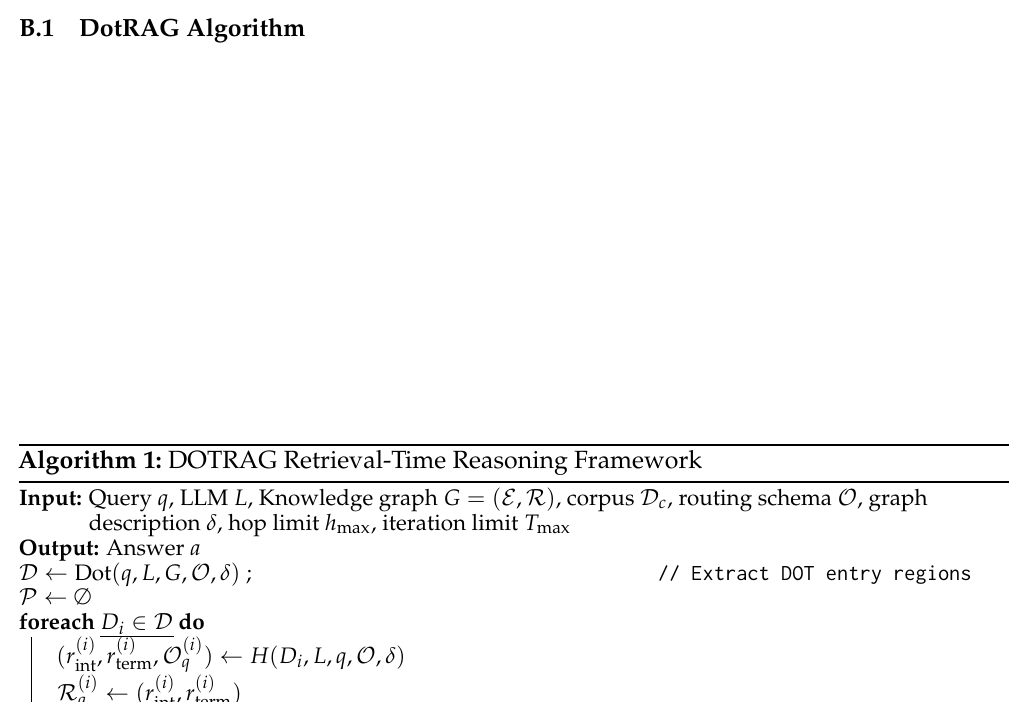
6. Path Aggregation:合并路径并生成答案

DOTRAG-algorithm1-framework

Algorithm 1 概括了整体流程:先抽 DOT entry regions,再为每个 DOT 生成规则、构建子图、搜索路径,最后合并路径。

所有 DOT 的路径集合为:

P=\bigcup_i P_{D_i}

最终从路径上的实体取 grounded chunks,按 query 相似度排序,把 paths + top-ranked chunks 送入 LLM 生成答案:

a=F(q,L,D_c,P)

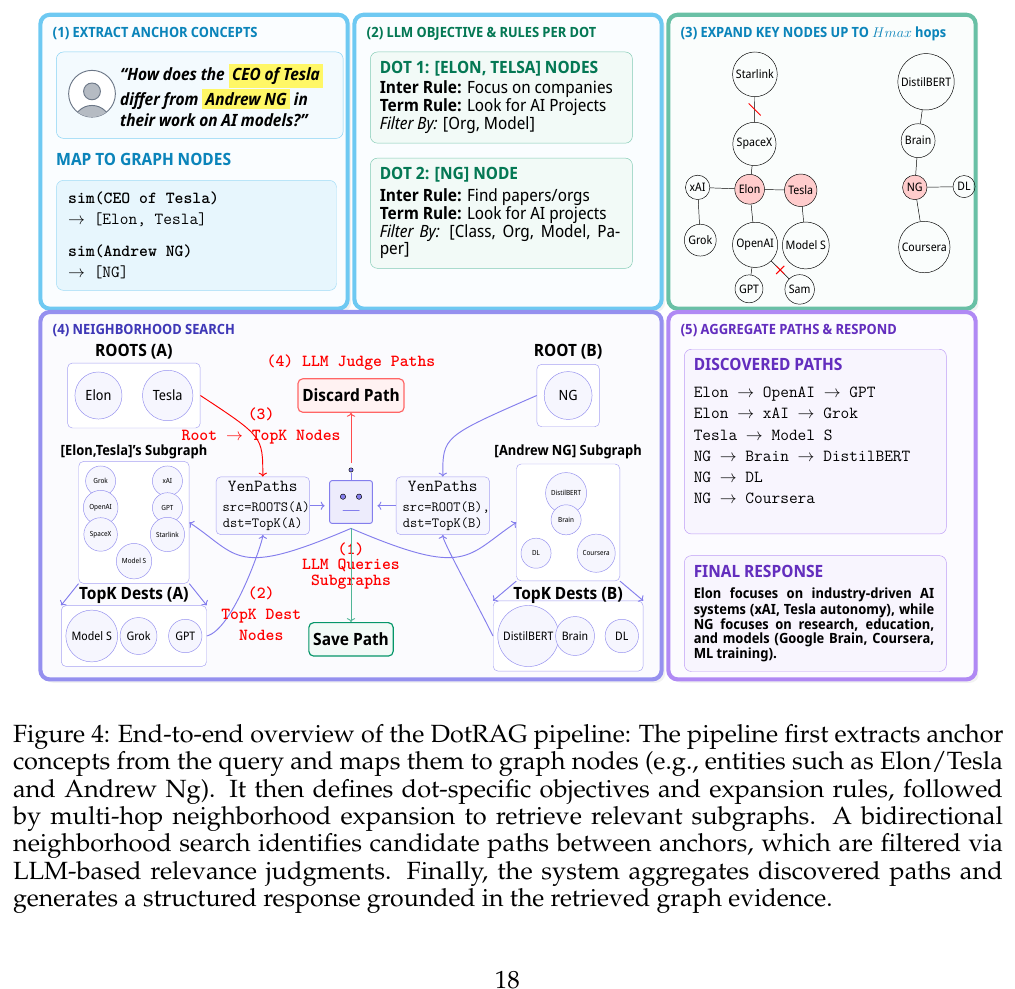
DOTRAG-fig4-full-pipeline

Figure 4 是最完整的 pipeline 图:query 先被映射到 Elon/Tesla 与 Andrew Ng 两个 DOT;每个 DOT 生成自己的目标规则和类型过滤;局部搜索用 TopK node retrieval + YenPaths 找候选路径;LLM judge 过滤路径;最后聚合发现的路径回答问题。

Results

1. 实验设置

  • 数据集:MetaQA 1-hop / 2-hop / 3-hop;UltraDomain-CS;UltraDomain-Mixed。
  • 规模:MetaQA 每个 hop 300 问,共 900;UltraDomain 两个子集共 200;总计 1,100 questions。
  • Baselines:TradRAG、LightRAG、PathRAG。
  • Backbone:GPT-4o-mini 用于各方法;GPT-4.1 用作 LLM-as-a-judge。
  • 默认 DOTRAG 设置:$h_{max}=3$,$T_{max}=3$。
  • 检索指标:node-level Recall、Precision、F1。
  • 生成指标:pairwise LLM judge win rate,维度包括 Comprehensiveness、Logicality、Relevance、Coherence、Overall。

2. 生成质量:多跳和跨域总体胜率高,但 CS 对 PathRAG 不占优

DOTRAG-table1-generation-winrate

Table 1 报告 DOTRAG 相对 baselines 的 win rate:

  • MetaQA 上,DOTRAG 对 PathRAG / LightRAG / TradRAG 的 Overall win rate 在 2-hop / 3-hop 上通常更高,例如对 PathRAG 为 65% / 74%,对 LightRAG 为 75% / 85%。
  • UltraDomain-Mixed 上,DOTRAG 相对 PathRAG / LightRAG / TradRAG 的 Overall win rate 分别为 70% / 83% / 78%。
  • UltraDomain-CS 上,DOTRAG 对 PathRAG 的 Overall 只有 46%,说明并非所有构造出来的 CS query 都需要显式多跳路径推理;一些问题可能被更简单路径或更少上下文回答。

解读:DOTRAG 的收益主要来自 query 本身确实需要 multi-hop path dependency 的场景;如果问题实际偏单跳或中间节点冗余,完整路径证据可能反而降低 coherence。

3. 检索质量:MetaQA 2-hop / 3-hop F1 最强

DOTRAG-table2-retrieval-quality

Table 2 显示:

  • 2-hop:DOTRAG Recall 91.90,F1 8.55,均高于 PathRAG / LightRAG / TradRAG。
  • 3-hop:DOTRAG Recall 55.31,F1 8.24,均为最佳。
  • 1-hop:TradRAG F1 10.24 最高,LightRAG Recall 98.86 最高;DOTRAG 保持竞争力但不是最佳。

解读:DOTRAG 对长路径更有价值。1-hop 任务不需要复杂路径约束,传统 chunk retrieval 可能用更少噪声命中答案。

4. 消融:3 iterations / 3 hops 是生成质量与检索覆盖的折中点

DOTRAG-table3-generation-ablation

Table 3 比较默认 DOTRAG 与 1Iter、6Iter、1Hop、10Hop 配置的生成 win rate:

  • 1Iter 在 3-hop 上明显弱于默认设置,说明单轮搜索不足以逐步发现多跳路径。
  • 6Iter 在检索上可能提高 recall,但生成质量不稳定,说明更多路径不一定带来更好答案。
  • 1Hop 和 10Hop 都不是稳健选择:前者欠扩展,后者容易带入噪声。

DOTRAG-table4-retrieval-ablation

Table 4 显示:

  • 6Iter-DOTRAG 在 2-hop / 3-hop F1 上较强,但不对应稳定生成收益。
  • 10Hop-DOTRAG 提高部分 recall,例如 3-hop Recall 56.40,但 precision 下降明显。
  • 1Hop-DOTRAG recall 大幅下降,尤其 2-hop / 3-hop。

解读:GraphRAG 的核心不是盲目提高 coverage,而是控制 search budget 和 path acceptance,使 retrieved path 同时满足覆盖和低噪声。

Limitations

  • 依赖 graph schema metadata:需要实体类型定义 $O$ 和全局 graph description $\delta$;论文实验中这些描述由用户检查后手动提供。
  • LLM prompt 依赖明显:concept extraction、DOT rule generation、path judgment、follow-up query 都依赖 LLM 稳定性。
  • 不是完全低成本:默认使用 GPT-4o-mini,评估使用 GPT-4.1 judge;每个 DOT 多轮搜索还要多次 LLM 判断路径。
  • MetaQA 评测没有 intermediate relation supervision:论文也指出原始 ground truth 只包含 starting node 和 endpoint,不能验证具体中间路径是否完全正确。
  • UltraDomain multi-hop questions 来自 sampled graph paths + LLM generation,可能包含不需要真实多跳推理的问题;CS 子集对 PathRAG 不占优就是信号。
  • Precision 绝对值仍低:Table 2 中 DOTRAG precision 约 4-5,说明即使有 DOT 约束,retrieved node set 仍比较宽。
  • 当前未提供官方代码链接,复现实验需要自己重建 graph construction、DOT prompts、YenPaths 和评估脚本。

Future Directions

  • 作者 Future Work:增强 MetaQA 的 intermediate hop supervision,以更细粒度评估多跳路径 traversal。
  • Agent 推断的 Research Opportunities:
    • 把 DOT rule generation 从 prompt-only 改成可记录的 structured path contract,显式保存 allowed entity types、intermediate predicates、terminal conditions。
    • 将 DOTRAG 与 STAR - Semantic-Tuned and Tail-Adaptive Retriever for GraphRAG 结合:STAR 训练 path scorer,DOTRAG 提供 query-specific local search space 和 path acceptance。
    • 将 DOTRAG 与 BubbleRAG - Evidence-Driven RAG for Black-Box KGs 对照:BubbleRAG 优化 evidence subgraph,DOTRAG 优化 query-conditioned accepted paths。
    • 扩展 OP-9:新增 path acceptance precision、partial-to-complete conversion rate、DOT-local retrieval recall、path-prefix redundancy rate。
    • 扩展 OP-10:把 DOT 作为 agentic traversal 的并行 workspace,记录每个 DOT 的 cost、accepted paths、follow-up queries 和 final-used paths。
    • 做 query router:1-hop / low-complexity query 走轻量 RAG 或 PathRAG,multi-hop dependency query 再启用 DOTRAG。

与本知识库的连接

一句话定位

DOTRAG 把 GraphRAG 从静态 retrieve-then-reason 推向 retrieval-time path reasoning:先为 query 建多个 DOT 局部工作区,再用 LLM 约束、局部向量检索、Yen shortest paths 和路径判断迭代发现可用多跳证据路径。