研究问题与动机
- 研究问题:Piping and Instrumentation Diagrams(P&ID)是过程工程中的核心图纸,包含设备、管线、仪表、阀门、控制关系和设计参数。直接把原始图像或 Proteus / DEXPI 智能文件交给 LLM,会遇到图像细节误读、XML / smart-file token 成本高、结构噪声多、远距离关系难关联等问题。
- 为什么重要:这类工程图纸不是普通图片,也不是普通文本。它有领域原生结构、可验证 schema、数值参数和连通关系;GraphRAG 的价值在这里不是“多召回几个 chunk”,而是把图纸变成可查询、可遍历、可执行的结构化上下文。
- 现有路线:
- M3KG-RAG - Multi-hop Multimodal Knowledge Graph-enhanced RAG 和 MMGraphRAG - Interpretable Multimodal Knowledge Graphs 关注多模态对象 / item grounding。
- SEM-RAG - Structure-Preserving Multimodal Graph Compilation 关注表格、公式、layout 和条件逻辑的结构保真。
- DualGraph - Symbolic Querying and Semantic Retrieval for Semi-Structured QA、QO-Bench - Query-Operator-Preserving Retrieval over Typed Event Tuples 和 CacheRAG - Semantic Caching for KGQA 说明半结构化任务需要区分语义检索、schema-aware 编译和符号执行。
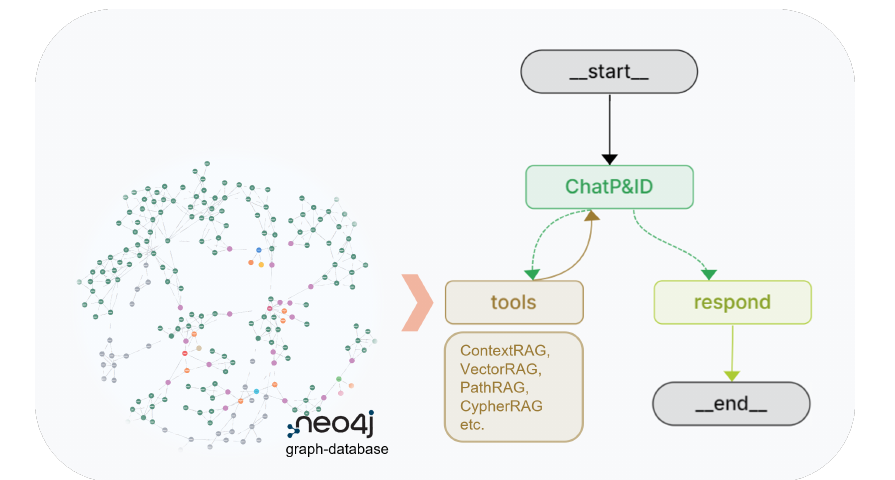
- 对本知识库的意义:ChatP&ID 把 OP-19 从文档 / 图片扩展到工程图纸,把 OP-11 从“semantic retrieval vs symbolic execution”扩展到同一领域图上的 ContextRAG / VectorRAG / PathRAG / CypherRAG 工具选择。
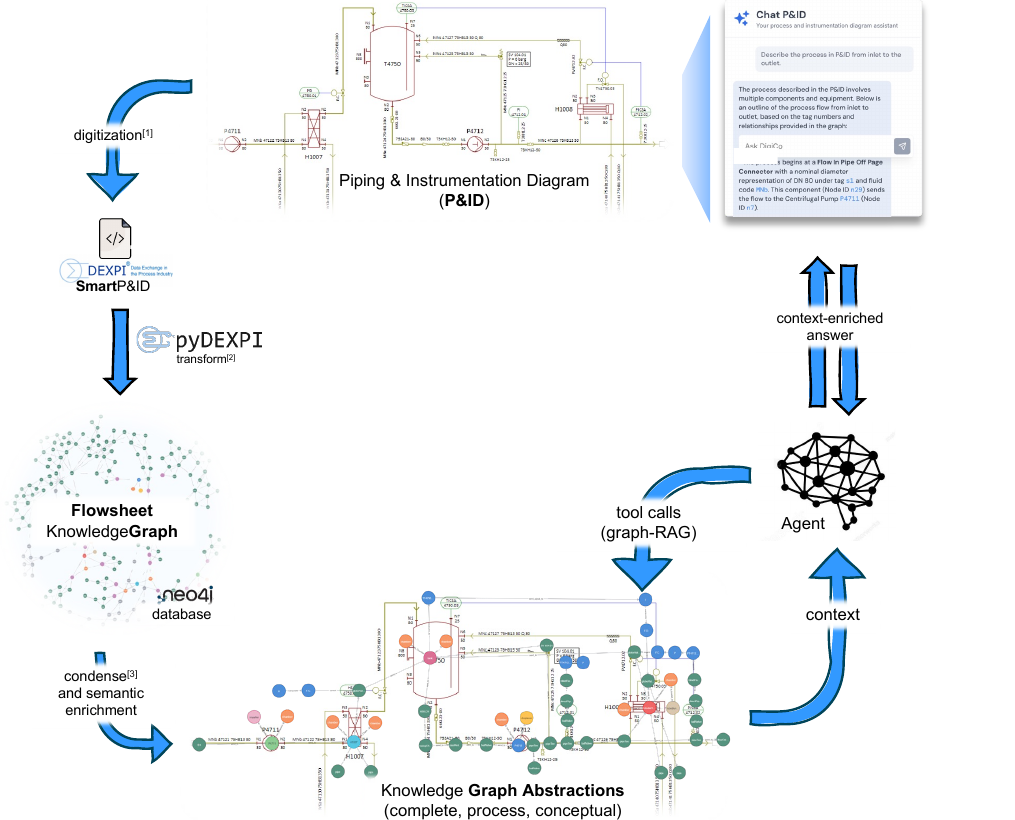
Figure 2 的关键信号是:ChatP&ID 不把 P&ID 作为一张图片处理,而是走 P&ID -> DEXPI SmartP&ID -> pyDEXPI -> Flowsheet Knowledge Graph -> abstraction layers -> agent tool calls -> context-enriched answer。图的价值在于把工程对象、管线连通性和领域参数变成检索接口,而不是只给视觉模型读图。
- Raw image is cheap but brittle:图像输入成本低,但对精确数值、仪表 tag、阀门参数和细小文字容易误读。
- Smart file is rich but noisy:Proteus / DEXPI 文件信息完整,但直接输入 LLM 会包含大量机器结构、URI、内部标识和 schema 噪声,token 成本很高。
- One interface is insufficient:工程问题既有“查某个参数”的精确查询,也有“沿管线追踪”的路径查询,还有“总结系统结构”的全局上下文查询;单一向量检索或单一 Cypher 查询都不稳定。
- Small models struggle with structured data:本地小模型难以稳定解析 GraphML / Proteus XML,但如果把部分工作交给 vector search 或 graph traversal,仍有机会改善。
- Deployment needs state visibility:工具调用可能慢、循环或格式不受控;工程场景需要流式状态、工具调用记录、响应格式约束和成本控制。
方法与机制
1. 总体框架:P&ID -> DEXPI -> LPG / Neo4j -> GraphRAG tools -> Agent answer
输入:用户问题 $q$、DEXPI-conformant smart P&ID、pyDEXPI object、Neo4j flowsheet knowledge graph、可选工具集合 $\mathcal{T}={\text{ContextRAG},\text{VectorRAG},\text{PathRAG},\text{CypherRAG}}$。
计算链路:
- 图构建:用 pyDEXPI 把 smart P&ID 转成 LPG 图:
节点保留 class label、tag、设计参数、阀门类型、material / pressure / temperature 等 data attributes;边保留 has-type、send_to、control、manipulate 等关系。
- 图抽象:从 complete-level graph 逐步压缩到 process-level graph 和 conceptual-level graph,减少低信息节点、非过程属性和过细层级。
- Agent routing:LLM 接收用户问题后,决定是否调用工具,以及调用哪个工具、传入哪些参数。
- Tool execution:工具在 Neo4j / vector index / GraphML context 上执行检索,返回 textual context。
- Answer synthesis:agent 判断上下文是否足够;若不足,继续调用工具直到达到最大工具次数或信息足够。
输出:带图证据 grounding 的自然语言回答、工具调用轨迹、上下文片段。
直观解释:ChatP&ID 的 GraphRAG 不是一个固定检索器,而是一个领域图上的工具选择框架。
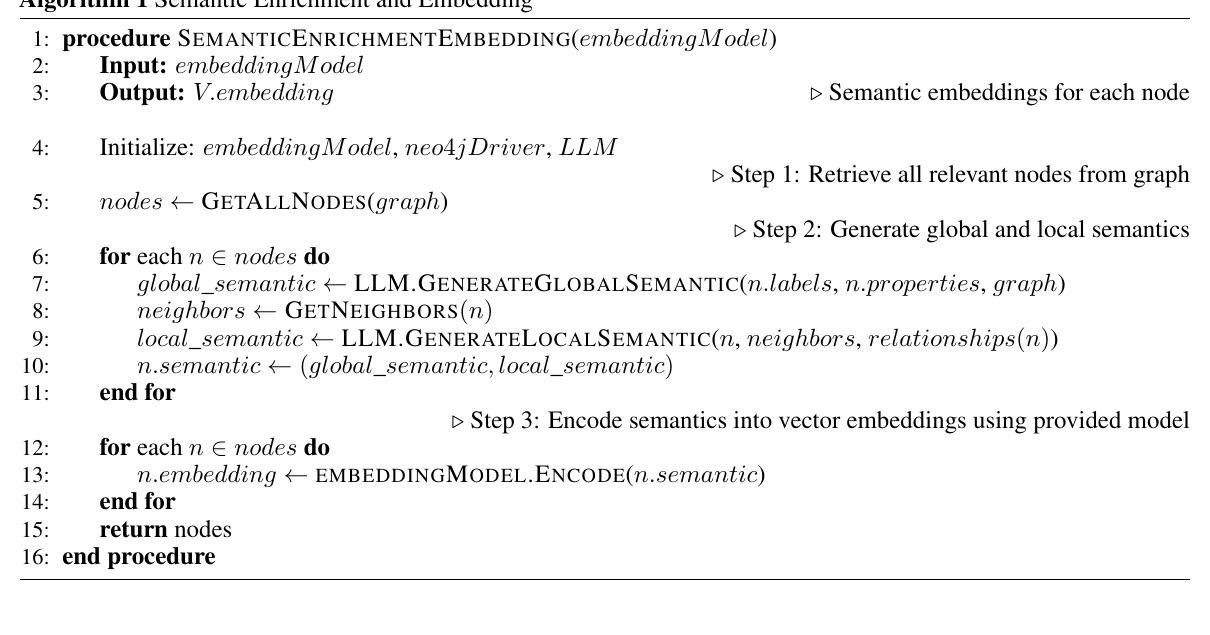
2. Semantic enrichment and embedding:给每个工程节点生成 local / global semantics
输入:图节点 $v$、邻居 $\mathcal{N}(v)$、节点属性 $\mathrm{prop}(v)$、全局图 $G$、LLM、embedding model。
计算链路:
- Local semantics:让 LLM 根据节点本身、邻居和关系生成局部语义:
- Global semantics:让 LLM 根据节点在整个 flowsheet 中的角色生成全局语义:
- Embedding:把 local / global semantic descriptions 投到向量空间:
论文实现使用 Voyage-3.5-lite,生成 1024 维向量。
输出:节点属性中的 semantic text 和 vector embeddings。
直观解释:原始 pyDEXPI 节点可能是工程 schema 对象,不一定和自然语言问题同分布;semantic enrichment 把工程节点改写成可被语义检索命中的文本表示。
3. ContextRAG:把 GraphML 过滤成低噪声结构上下文
输入:Neo4j 图 $G$、agent 选择的模式 $m\in{\text{graph},\text{topology}}$。
计算链路:
- Export:从数据库导出 GraphML。
- Filter:删除内部 ID、URI、vector embedding、非语义元数据等噪声。
- Reconstruct:按模式重建上下文:
- Graph mode:保留关键 node / edge attributes,例如 label、tag number、设计参数和关系类型。
- Topology mode:只保留 node labels 和 connectivity。
输出:可直接交给 LLM 解析的 condensed GraphML / textual graph context。
直观解释:ContextRAG 适合全局理解和需要完整上下文的问答,但当图纸跨多页变大时,成本会随图规模线性上升。
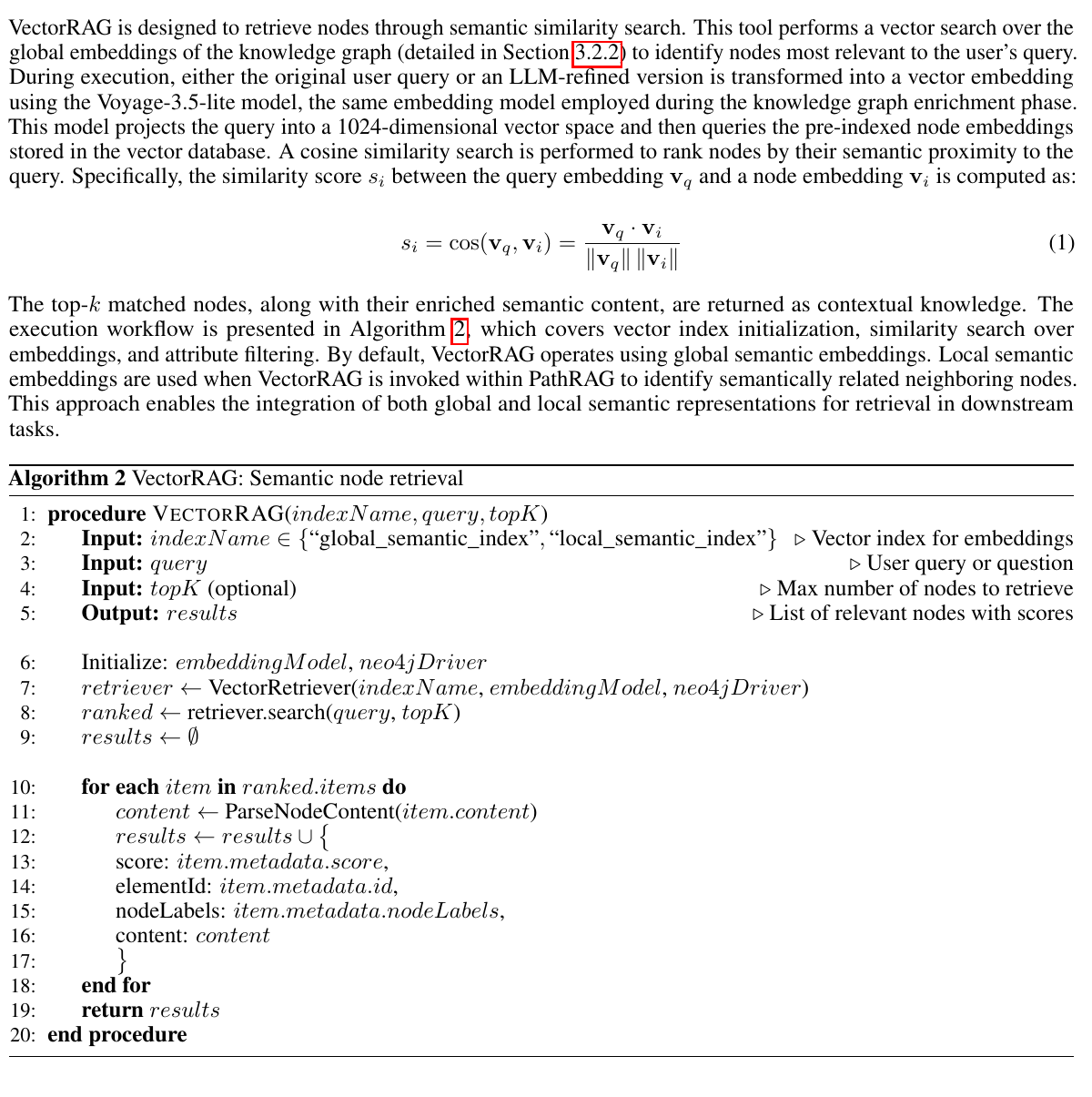
4. VectorRAG:用语义相似度检索工程节点
输入:用户问题或 LLM-refined query $q$、index name、top-$k$。
计算链路:
- Query embedding:
- Cosine similarity search:
- 返回 top-$k$ 节点及其 node labels、elementId、semantic content 和 score。
输出:按语义相关性排序的工程节点列表。
直观解释:VectorRAG 适合“找到与这个自然语言问题最相关的设备 / 节点”,速度较快,成本低;但它本身不保证沿管线连通关系完整。
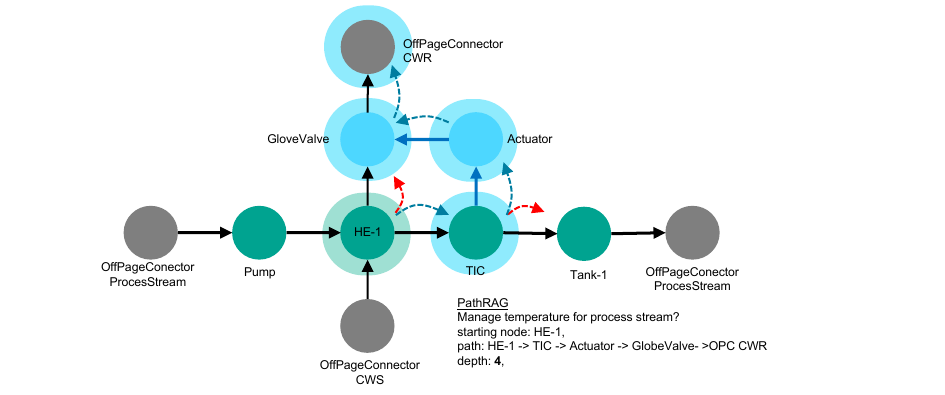
5. PathRAG:先定位节点,再沿工程连接追踪路径
原始笔记摘录已截断;请打开来源笔记阅读完整内容。
证据与结果
1. 图表示比原始图像和 smart file 更适合精确工程问答
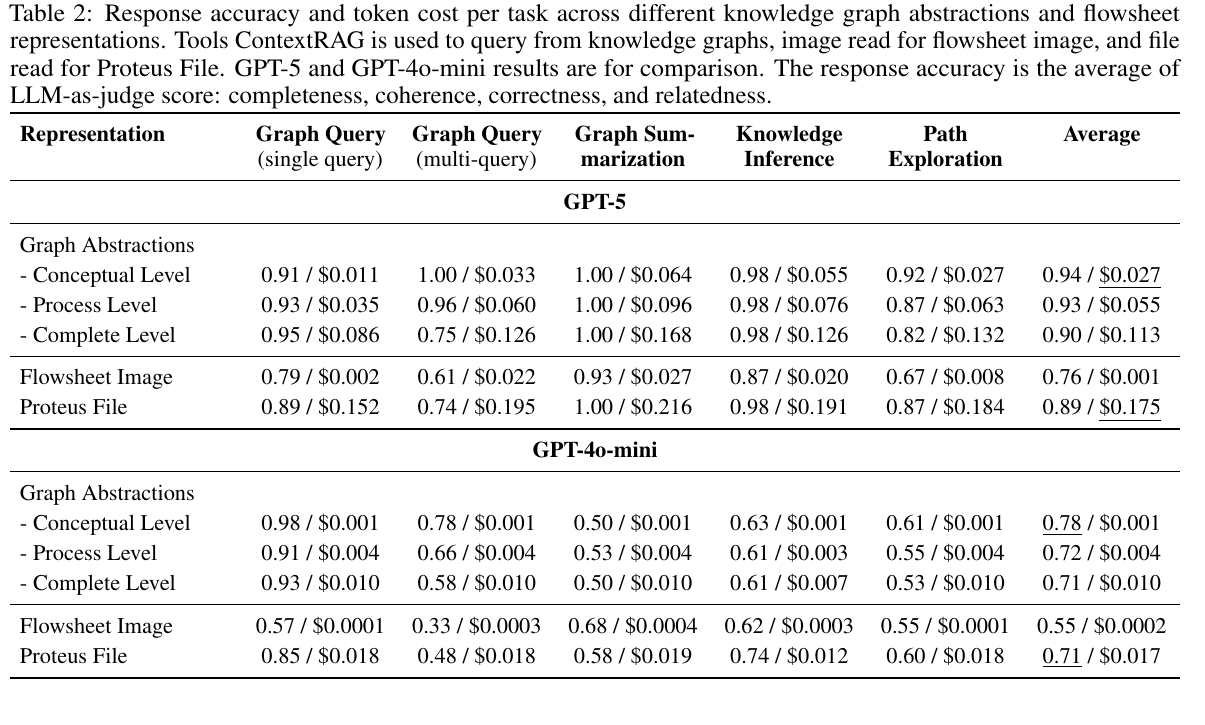
Table 2 显示,GPT-5 使用 conceptual graph + ContextRAG 的平均准确率为 0.94,raw flowsheet image 为 0.76,Proteus file 为 0.89;conceptual graph 的平均成本 $0.027,Proteus file 为 $0.175,约降 85%。这说明“把图纸编译成适当抽象层级的图”同时改善精确性和成本。
2. ContextRAG 是最强总体工具,但不是唯一合理工具
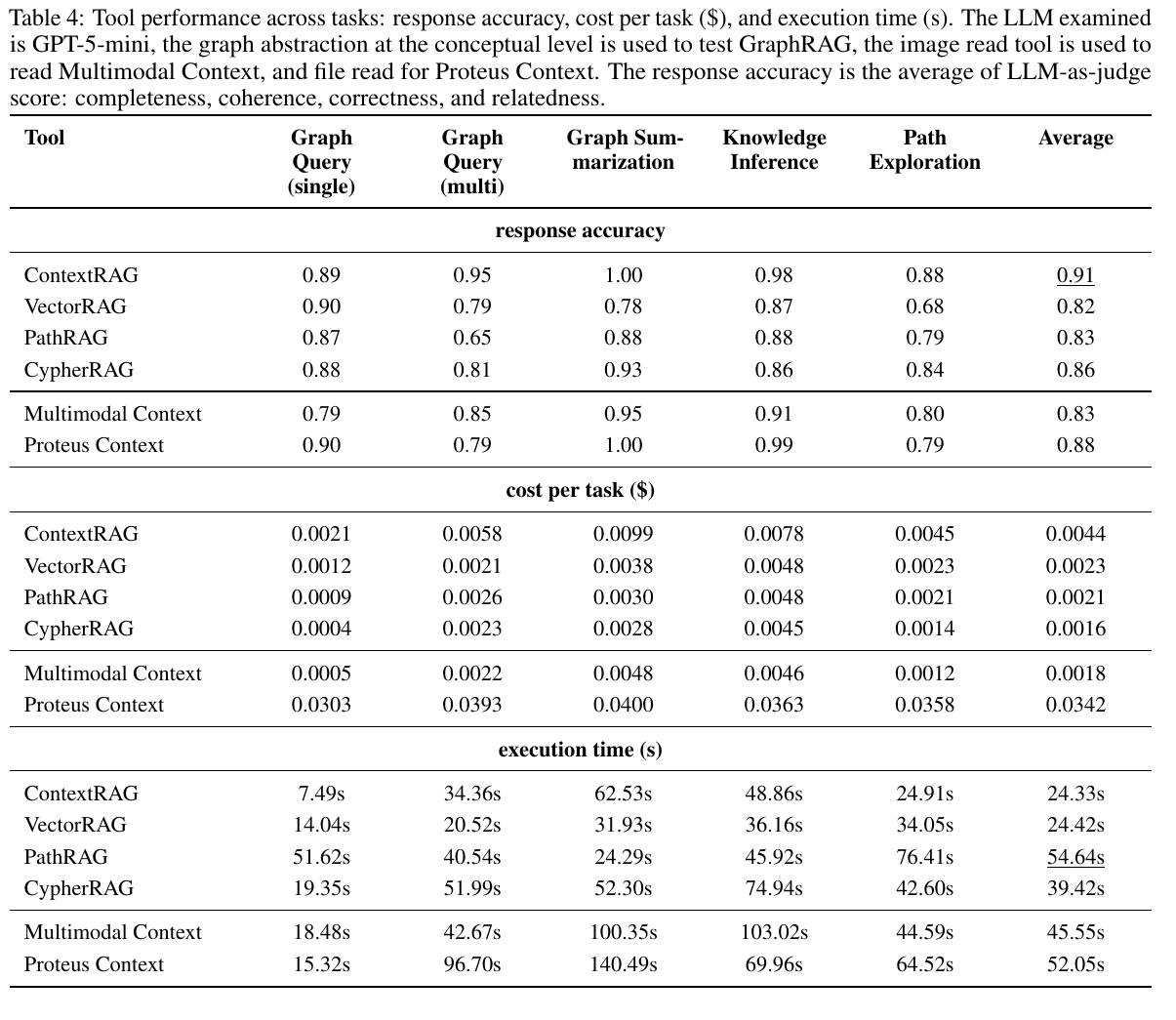
Table 4 使用 GPT-5-mini 和 conceptual graph 比较工具。ContextRAG 平均准确率 0.91、平均成本 $0.0044、平均时间 24.33s;VectorRAG / PathRAG 平均准确率为 0.82 / 0.83,但成本更低;CypherRAG 平均 0.86,在 graph summarization 和 single graph query 上表现强。这个表直接支持工具路由:不是所有 query 都应走同一 GraphRAG 接口。
3. 全局性能显示 task type 和模型能力共同决定工具选择
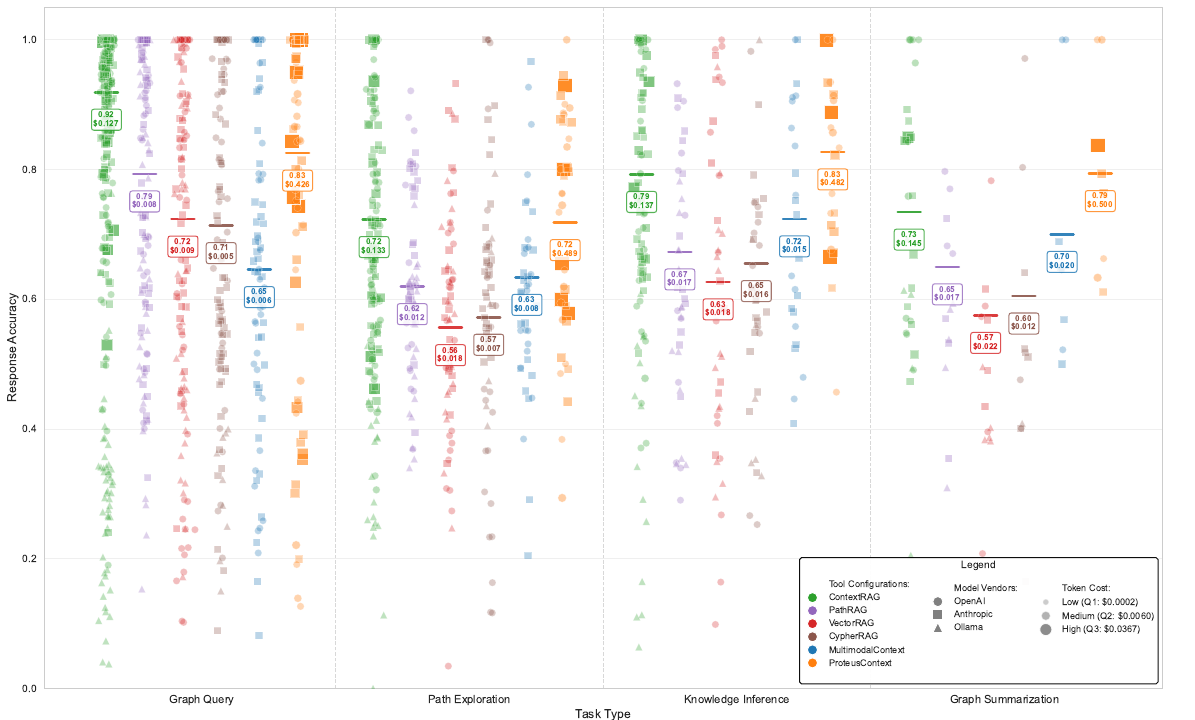
Figure 8 按 graph query、path exploration、knowledge inference、graph summarization 分组。绿色 ContextRAG 总体最高,Proteus context 成本高,raw multimodal context 成本低但在精确查询和路径追踪上不稳;PathRAG / VectorRAG 以低成本覆盖部分任务,适合做局部或小模型辅助。
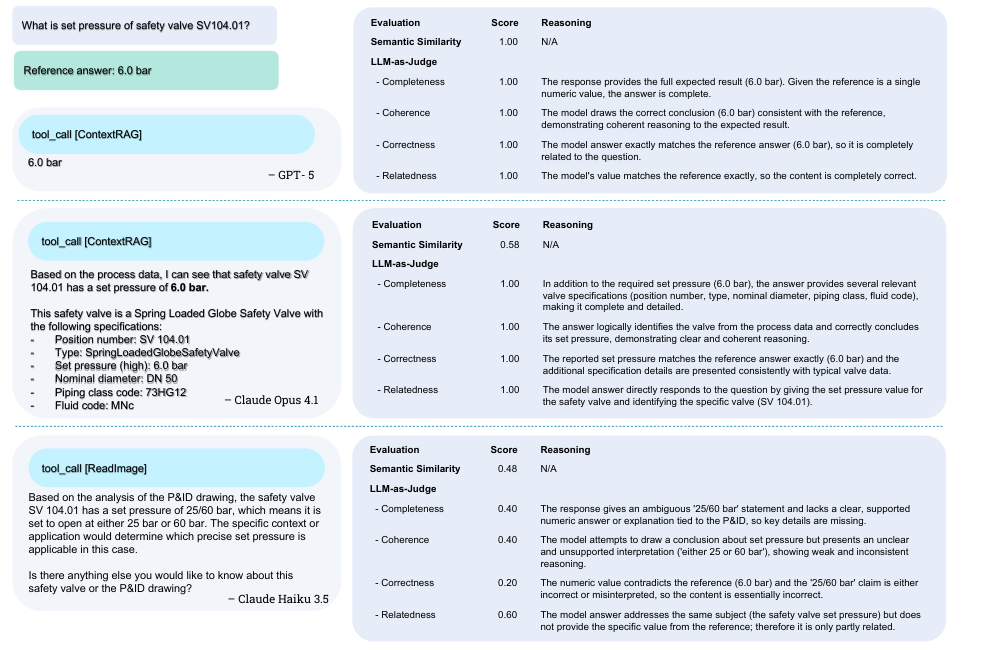
4. 图证据能避免图像读图的数值误判
Figure 7 的案例是查询 safety valve set pressure。ContextRAG 给出 6.0 bar 并被 LLM-as-judge 判为正确;Claude Haiku 读图时把 25/60 bar 之类的图像文字误当答案。这个案例也说明 semantic similarity 分数可能误导:语义相似不等于数值和逻辑正确。
局限与开放问题
-
单页简单 P&ID:实验图纸是相对简单、单页、高分辨率 P&ID;真实工业 P&ID 更密集、多页、字体更小,图像和图抽象都会更难。
-
ContextRAG 随图规模线性变贵:如果每次把完整 GraphML / graph context 放入 LLM,多页 flowsheet 会快速推高 token cost。
-
小模型仍然难以读复杂结构:Ollama 本地模型在 GraphML / Proteus XML 上耗时长且表现弱,虽然 VectorRAG / PathRAG 可改善,但不能完全替代强模型。
-
CypherRAG 没有做迭代修复:论文限制为单次 Cypher 生成;如果加入数据库错误反馈和 human-in-the-loop,结果可能不同。
-
工具循环和输出格式需要治理:作者明确观察到 infinite tool iteration、过长上下文、response format 欠指定、prompt caching 低效和状态不可见等部署失败模式。
-
citation / 发表状态待复查:本轮 Semantic Scholar 查询遇到 429,正式发表版本和引用情况尚未确认。
-
工程图纸 GraphRAG benchmark:扩展到多页、高密度、跨页 off-page connector、复杂控制回路和真实 HAZOP 问答。
-
Tool router:学习或规则化地选择 ContextRAG / VectorRAG / PathRAG / CypherRAG / image fallback / file fallback,并记录每类 query 的工具收益。
-
Cypher repair loop:加入 schema-aware query repair、database feedback、execution trace 和 predicate grounding,降低单次 Cypher 生成失败。
-
PathRAG calibration:记录起点命中、下一跳选择、path sufficiency、路径长度、局部语义相似度和最终答案使用的 path,做路径级诊断。
-
Multi-agent process engineering:把 ChatP&ID 扩展为 supervisor + 多个 tool agents,用于 HAZOP、流程修改、风险检查和设计审查。
-
Grounding audit:为每个回答记录
retrieved node/path -> graph attribute -> final claim,区分 image-read error、graph abstraction loss、tool routing error 和 final synthesis error。
关联与拓展
- 2026-06-09-Open-Problems OP-11:ChatP&ID 是 graph interface routing 的领域案例,同一 P&ID 图上同时需要 ContextRAG、VectorRAG、PathRAG 和 CypherRAG。
- 2026-06-09-Open-Problems OP-12:它提供 stage-aware structured GraphRAG deployment 证据,说明 DEXPI / pyDEXPI / Neo4j / local-vector-index / LLM agent 应分阶段配置。
- 2026-06-09-Open-Problems OP-17:Figure 7 说明 retrieval / grounding 正确后,还要防 image misread、semantic-similarity false confidence 和 final numeric synthesis error。
- 2026-06-09-Open-Problems OP-19:它把 multimodal / layout-preserving GraphRAG 扩展到工程图纸和领域原生 graph schema。
- GraphRAG中的图接口选择与任务类型:ChatP&ID 是最直接的工具接口选择案例。
- Query Execution 与 Retrieval 的区别:CypherRAG 体现 query execution,VectorRAG / PathRAG / ContextRAG 更偏 retrieval / traversal / context reading。
- GraphRAG中的查询语义、逻辑约束与数据库视角:P&ID 问答包含 schema、路径、数值参数和领域约束。
- 结构化检索中的Faithfulness与Coverage:图像误读案例说明 answer faithfulness 不能只看语义相似度。
- GraphRAG中的图构建质量、表示保真与下游回答质量:DEXPI -> LPG 把领域结构保真放到 ingestion 阶段。
- SEM-RAG - Structure-Preserving Multimodal Graph Compilation:两者都强调结构编译,但 SEM-RAG 面向标准文档,ChatP&ID 面向工程图纸。
- MMGraphRAG - Interpretable Multimodal Knowledge Graphs 和 M3KG-RAG - Multi-hop Multimodal Knowledge Graph-enhanced RAG:ChatP&ID 与它们共同补齐 OP-19 的多模态 / 结构化证据线。
- CacheRAG - Semantic Caching for KGQA:都强调 schema-aware execution / tool selection,只是 CacheRAG 聚焦 KGQA plan cache,ChatP&ID 聚焦工程图纸工具接口。
研究问题入口
Q1 领域边界与适用性, Q2 图构建与表示, Q3 证据检索与集合形成, Q4 查询规划与执行, Q6 证据来源与可解释性